

Why Is a 520nm Green Laser Module Easier to See in Ambient Light?


Have you ever tried to align machinery in a sunlit facility only to find your laser line completely washed out? Industrial environments, outdoor job sites, and brightly lit machine shops create high ambient light conditions. These intense environments often render traditional red lasers completely invisible to the human eye. To solve this, engineers face a distinct safety-power paradox. Increasing the output power of a laser to improve visibility introduces severe eye-safety compliance risks. Higher power also creates complex thermal management issues causing premature equipment failure. Fortunately, modern optics offer a safer, more effective solution. Transitioning to specific wavelengths—specifically the 520nm green diode—allows you to maximize perceived brightness without exceeding strict power regulations. This article explains the core physics behind green laser visibility. We will compare 520nm direct-diode technology against legacy alternatives. You will also learn a practical framework for specifying these advanced modules in demanding commercial applications.
Key Takeaways
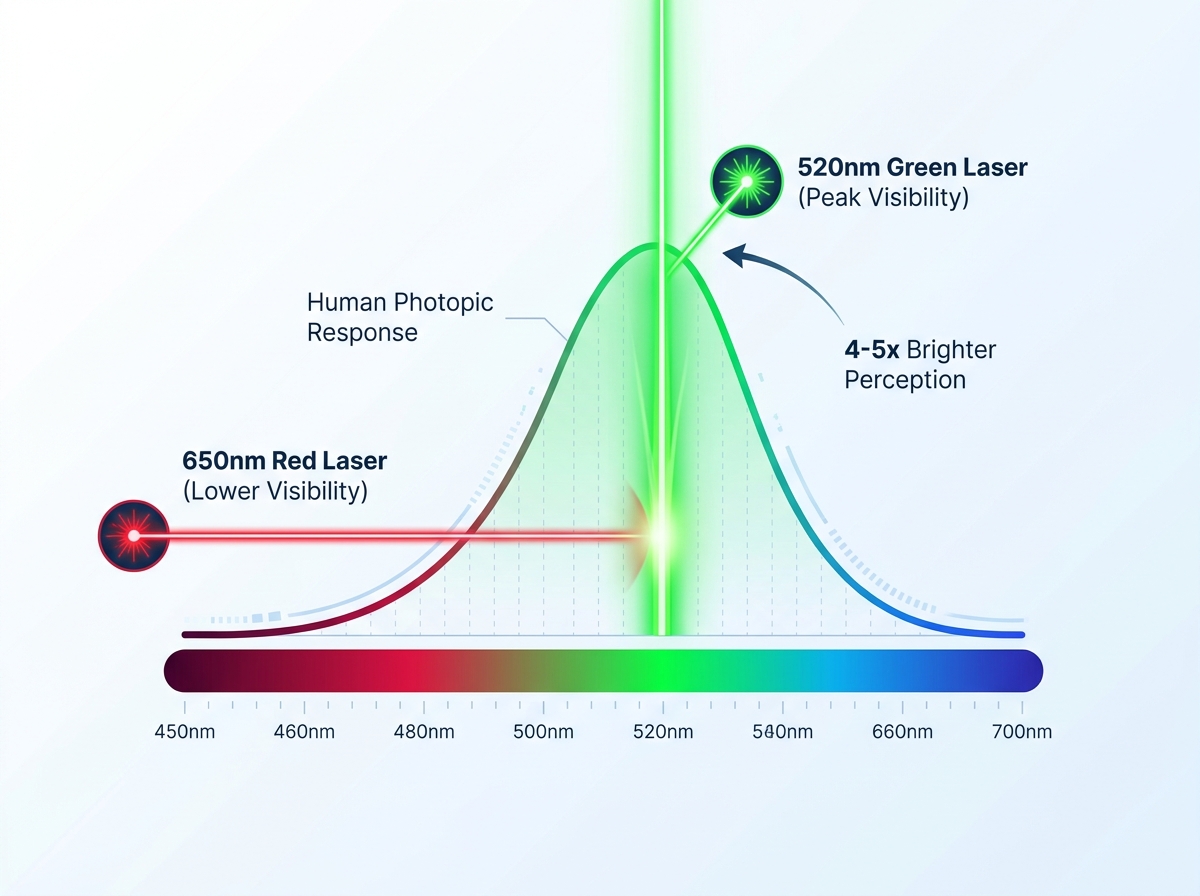
Human photopic vision peaks in the green spectrum, making a 520nm beam appear up to 4–5 times brighter than a red beam of the exact same optical power.
520nm direct-diode lasers eliminate the temperature sensitivity and fragility of older 532nm DPSS (Diode-Pumped Solid State) lasers.
Upgrading to a 520nm module improves alignment accuracy and operational efficiency in high-ambient-light settings without violating Class 2 or 3R safety classifications.
The Physics of Visibility: Wavelength vs. Raw Output Power
Perceived brightness is a biological phenomenon, not purely a physical measurement of photons. The human eye does not perceive all light wavelengths equally. Our visual system relies on specialized photoreceptor cells called cones for daylight vision. Biologists and optical engineers refer to this as photopic vision.
The photopic response curve maps human visual sensitivity across the electromagnetic spectrum. This curve peaks precisely at 555 nanometers (nm). Light at this wavelength appears inherently brighter to our eyes than any other color. Red lasers typically operate at 650nm. This wavelength sits far down the slope of the visual sensitivity curve. Because of this biological bias, a 520nm green laser aligns much closer to our visual peak.
This biological reality creates a dramatic power equivalency advantage. We can compare a 5mW 520nm green laser against a 5mW 650nm red laser. Both emit the exact same amount of raw optical power. However, the green beam will appear exponentially brighter to the naked eye. In practical terms, it looks four to five times brighter than its red counterpart. You can clearly see a 5mW green line across a brightly lit factory floor. A 5mW red line often vanishes within a few feet.
Leveraging wavelength sensitivity provides a critical regulatory advantage. Manufacturers face strict safety regulations regarding laser output power. Regulatory bodies classify lasers based on potential eye damage. A Class 3R laser must stay under 5mW of continuous output. If you need higher visibility, you cannot simply increase a red laser to 20mW without changing its safety class. A Class 3B laser requires rigorous safety interlocks, warning signs, and mandatory eye protection. By switching the wavelength to 520nm, you stay well within the safe, compliant <5mW limit. You achieve the visual performance of a non-compliant, high-power red laser while maintaining a standard Class 3R safety rating.
520nm Direct Diode vs. 532nm DPSS: Solution Categories
Not all green lasers use the same internal architecture. Engineers historically relied on 532nm DPSS technology to generate green light. Understanding the shift to modern direct diodes requires a brief look at this legacy technology.
Older 532nm DPSS (Diode-Pumped Solid State) lasers utilize a complex conversion process. They do not generate green light directly. Instead, they start by pumping an 808nm infrared (IR) diode into a neodymium-doped crystal. This produces 1064nm infrared light. A second crystal then halves the wavelength to 532nm. This multi-stage process creates severe drawbacks. DPSS lasers are highly sensitive to temperature fluctuations. The crystals require precise thermal alignment to function. They become very fragile under heavy vibration. Furthermore, they carry a risk of dangerous infrared leakage if the internal IR filters fail.
Modern architectural shifts introduced the 520nm direct diode. These semiconductor devices emit green light natively. They require no internal conversion crystals. The electrical current passes through the semiconductor, immediately producing the 520nm wavelength. This streamlined design revolutionizes how engineers deploy green lasers.
When conducting bottom-of-the-funnel (BOFU) evaluations, the direct diode wins across almost every technical dimension. First, they offer broader operating temperatures. You can typically deploy them in environments ranging from -20°C to +60°C. Older DPSS models often dim or fail entirely below 15°C. Second, they provide enhanced shock resistance. The absence of delicate floating crystals makes them ideal for heavy machinery. Third, they deliver a significantly longer Mean Time Between Failures (MTBF). Finally, direct diodes offer instant-on stability. They do not require the frustrating warm-up times associated with crystal stabilization.
Standard engineers often review specification sheets when shortlisting components. Integration teams frequently select modern Green Laser Modules specifically to avoid the downtime associated with legacy DPSS failures.
Comparison of Green Laser Technologies
Feature | 532nm DPSS (Legacy) | 520nm Direct Diode (Modern) |
|---|---|---|
Generation Method | Infrared conversion via dual crystals | Native semiconductor emission |
Operating Temperature | +15°C to +30°C (Highly restricted) | -20°C to +60°C (Broad range) |
Shock Resistance | Poor (Fragile internal crystal alignment) | Excellent (Solid-state semiconductor) |
Warm-up Time | Up to 5 minutes for stable output | Instant-on (Zero wait time) |
Infrared Leakage Risk | Yes (Requires secondary IR filters) | None (No IR pump used) |
When to Upgrade from a Standard Laser Module
Before upgrading your equipment, you must properly define the baseline. A typical baseline Standard Laser Module relies heavily on mass-produced 650nm red components. These components serve perfectly well in dimly lit, indoor environments. They work well for basic barcode scanners or short-range indoor leveling tools. However, they reveal severe limitations in demanding environments. When exposed to ambient sunlight or high-intensity factory lighting, the red beam loses its contrast. Operators strain to see the reference line.
Transitioning away from this baseline requires evaluating cost versus performance. You will acknowledge a higher upfront unit cost when purchasing a 520nm Green Laser Module. Direct green diodes utilize more complex semiconductor materials like Indium Gallium Nitride. This material science drives up manufacturing expenses. However, you must frame this initial cost against the hidden expenses of poor visibility. Invisible red lasers lead directly to alignment errors. Misaligned materials cause costly scrap. Operators also experience slower production times as they double-check faint reference lines. Furthermore, squinting at poorly defined lines accelerates worker fatigue and decreases daily output.
Upgrading becomes mandatory rather than optional in several high-value use cases. You should immediately transition to 520nm modules in the following scenarios:
Outdoor Construction Leveling: Surveyors and builders operate in direct sunlight. Red lasers vanish instantly outdoors. Green beams provide the contrast necessary to align foundations and framing over long distances.
Sawmill Timber Alignment: Sawmills utilize high-intensity overhead lighting. Operators need crisp, visible guidelines to position heavy timber. Green lasers cut through the bright ambient light and wood dust.
Medical Positioning Systems: Operating rooms use incredibly bright surgical lights. Patient positioning systems require distinct visual markers. The 520nm wavelength remains visible against surgical drapes and skin without requiring dangerous power levels.
Automotive Machine Vision: Automated inspection cameras often struggle with low-contrast reference lines on shiny metal parts. Green diodes provide sharp contrast on reflective aluminum and steel components.
Critical Evaluation Dimensions for an Alignment Green Laser
Selecting the right hardware requires more than just picking a wavelength. Engineers must evaluate several critical dimensions before integrating an Alignment Green Laser into an industrial system. Ignoring these factors leads to poor performance and premature degradation.
Beam profile and optics play a foundational role in module performance. You must prioritize proper collimation. An alignment module only proves effective if the generated line or dot remains crisp over a long distance. Low-quality optics produce thick, blurry lines that expand rapidly as they travel. This expansion destroys alignment accuracy. High-quality modules often utilize specialized optics. For line generation, Powell lenses distribute optical intensity evenly. Standard cylindrical lenses create lines with bright centers and faded edges. Powell lenses ensure the line remains uniform from edge to edge.
Thermal management dictates the lifespan of your diode. Direct green diodes run much more efficiently than older DPSS models. However, they still generate localized heat. You must account for proper heat sinking, especially in continuous-duty (CW) applications. If a diode runs continuously without a thermal escape path, its internal temperature spikes. This heat causes the wavelength to shift, altering the beam's color and stability. Eventually, poor thermal management causes premature diode degradation. Look for modules housed in robust brass or anodized aluminum bodies. These metals act as passive heat sinks.
Integration scalability determines how easily you can implement the technology across your production line. When shortlisting suppliers, engineers need to look for specific standardized features.
Standardized Form Factors: Ensure the supplier offers common housing diameters. The 10mm and 12mm cylindrical housings fit most existing industrial mounting brackets. This prevents the need for custom-machined clamps.
Acceptable Voltage Inputs: Check the internal driver board. Industrial systems commonly supply 3V to 5V DC power. The module should accept these standard inputs without requiring bulky external step-down converters.
Modulation Options: Modern machine vision systems often require the laser to strobe in sync with a camera shutter. Verify the module supports TTL (Transistor-Transistor Logic) or PWM (Pulse Width Modulation). These inputs allow rapid switching of the laser without damaging the diode.
Implementation Risks and Safety Compliance
Migrating to highly visible wavelengths introduces unique implementation risks. Engineers often fall victim to the "Brighter Equals Safer" fallacy. They assume a beam they can easily see is inherently safer to work around. This assumption proves dangerous. A Class 3R 520nm laser requires the exact same rigorous safety protocols as any other Class 3R laser. The biological damage threshold remains the same. You must implement administrative controls, post proper warning signage, and provide mandatory Personal Protective Equipment (PPE) if your local safety officer requires it.
Managing reflections becomes critical in bright ambient light. When you shine a highly visible green beam onto machined metal or glass, specular reflections occur. These stray beams can travel across a factory floor and strike unintended targets. To mitigate this, discuss integration angles with your design team. Projecting the laser at a slight angle prevents the beam from bouncing directly back into the operator's eyes. Whenever possible, utilize matte-surface targeting materials to diffuse the light safely.
Finally, you must navigate strict certification requirements. Never purchase uncertified modules for commercial applications. Remind buyers and procurement teams to verify supplier compliance. Your chosen module supplier must comply with IEC 60825-1 standards. If operating within the United States, they must meet FDA/CDRH regulations. Always request legitimate testing documentation. Reputable manufacturers provide test reports detailing exact output power, wavelength stability, and safety classifications.
Conclusion
Navigating high ambient light environments requires a calculated approach to optical engineering. By understanding the physics of human vision, you can bypass the limitations of traditional red beams.
The 520nm wavelength aligns with peak human visual sensitivity, offering superior brightness at compliant power levels.
Direct-diode architecture eliminates the fragility, warm-up times, and temperature restrictions of legacy DPSS models.
If your application involves high ambient light, severe temperature swings, or heavy vibration, a 520nm module represents the optimal engineering choice.
Proper thermal management and high-quality optics ensure long-term stability in continuous-duty applications.
Before committing to bulk procurement, take proactive next steps. Contact your supplier and request a sample module. Test the beam visibility, thermal stability, and integration ease directly within your specific operational environment.
FAQ
Q: Do Green Laser Modules consume more power than red lasers?
A: Yes, typically direct green diodes have a higher operating current and forward voltage than red diodes, requiring careful power supply planning in battery-operated devices.
Q: Why is my 520nm laser line thicker at the edges than the center?
A: This is a function of the optical lens (e.g., Powell lens vs. cylindrical lens), not the diode itself. High-quality modules use Powell lenses for uniform intensity distribution.
Q: Can a 520nm laser be used in freezing temperatures?
A: Yes. Unlike 532nm DPSS lasers which often fail or dim below 15°C, a 520nm direct diode typically operates reliably down to -20°C.